
Custom home or major renovation?
Sometimes the right move is to rebuild the space you already love. Sometimes the existing home fights the dream so hard that starting fresh is the cleaner path.
8 min read
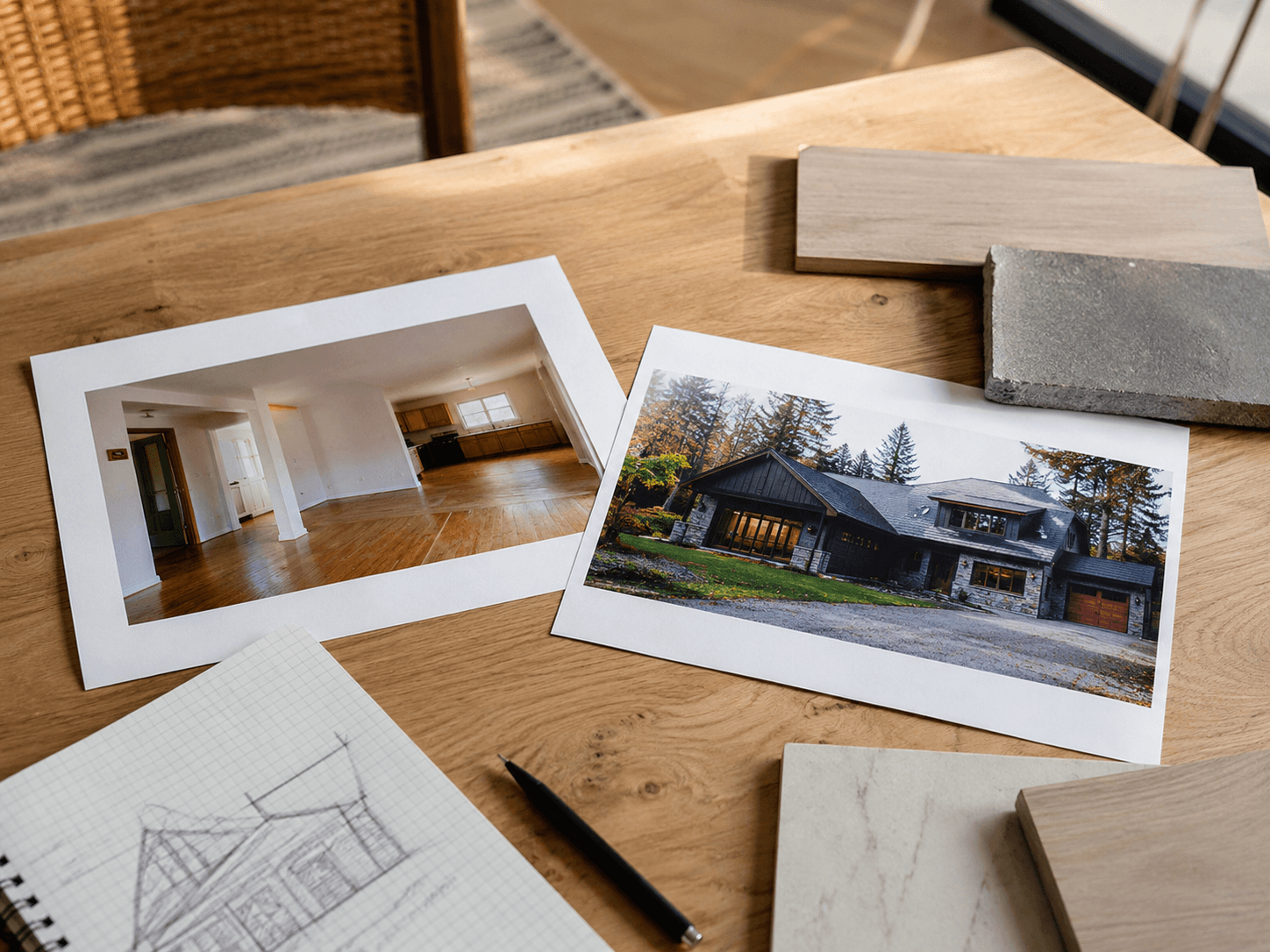
Look at what the existing home actually gives you.
Good bones, a great location, sentimental value, and a layout that can genuinely be improved are all real reasons a renovation might make more sense than starting over. If the foundation is solid, the roofline works, and the main structural issue is really just a dated layout, a renovation can get you most of the way to your dream home without the cost and time of a full rebuild. This is especially true when the lot itself, the view, the trees, the neighborhood, is a big part of why you love living there.
Be honest about what cannot be fixed easily.
Low ceilings, a poor or cracking foundation, awkward past additions, major water infiltration, and a layout that needs everything changed can make a renovation far more expensive than it first appears. Homeowners often underestimate how much it costs to fix a structural problem compared to designing around it correctly from the start. If your contractor keeps finding more issues the deeper they look, that is useful information, not a sales tactic. It might genuinely be cheaper, and less stressful, to start fresh.
Compare the real path, not just the dream photo.
It is easy to fall in love with a photo of a finished kitchen or a striking exterior and assume either option can get you there. A builder can help you compare the practical steps for each path: permit realities, site limits, structural constraints, budget, and timeline, before you commit emotionally to one direction. Sometimes a renovation and a custom build end up costing close to the same amount once everything is priced out, and the deciding factor becomes which process you would rather go through.
Think about how long you plan to stay.
A major renovation is disruptive, but it is usually faster than a full custom build. If your timeline is tight, or you are trying to avoid two moves, that alone might tip the decision. On the other hand, if you are building the home you plan to live in for decades, the extra time and cost of starting fresh can be worth it, since you get to make every decision instead of working around what already exists. This is a personal calculation as much as a financial one.
Consider the emotional cost of living through construction.
A major renovation often means living in a construction zone, or moving out temporarily, for months at a time. A custom build usually means living somewhere else entirely while the home is built from the ground up, which can actually be less stressful day to day, even though the overall project takes longer. Neither option is easy, but it is worth being honest with yourself about which kind of disruption you can actually tolerate before committing to a path.
Ask what a partial renovation could actually solve.
Not every renovation has to be all or nothing. Sometimes the honest answer is that a full custom build is not necessary, and a well-planned addition or a renovation of just the rooms that bother you most gets you 80 percent of the way there. A good builder will not push you toward the bigger, more expensive option by default. Part of an honest conversation is figuring out the smallest project that actually solves your real problem.
Get real numbers before you decide, not estimates from memory.
General cost per square foot numbers you find online rarely apply cleanly to a specific property or renovation scope. The only way to actually compare a renovation against a custom build is to get real numbers based on your actual home and land, not a rule of thumb. This usually means a site visit and an honest conversation about what your existing structure would need versus what a new build would cost from the ground up.
There is no universally right answer, only the right answer for your property.
Every homeowner asking this question is hoping for a simple rule, and there genuinely is not one. The right decision depends on your foundation, your budget, your timeline, your attachment to the property, and how much disruption you can handle. The best thing you can do is have this conversation early with a builder who is willing to talk you out of the more expensive option if the smaller one actually serves you better.
Want to talk through your own project?
Send the rough idea and Matt can help make the next step clearer.